
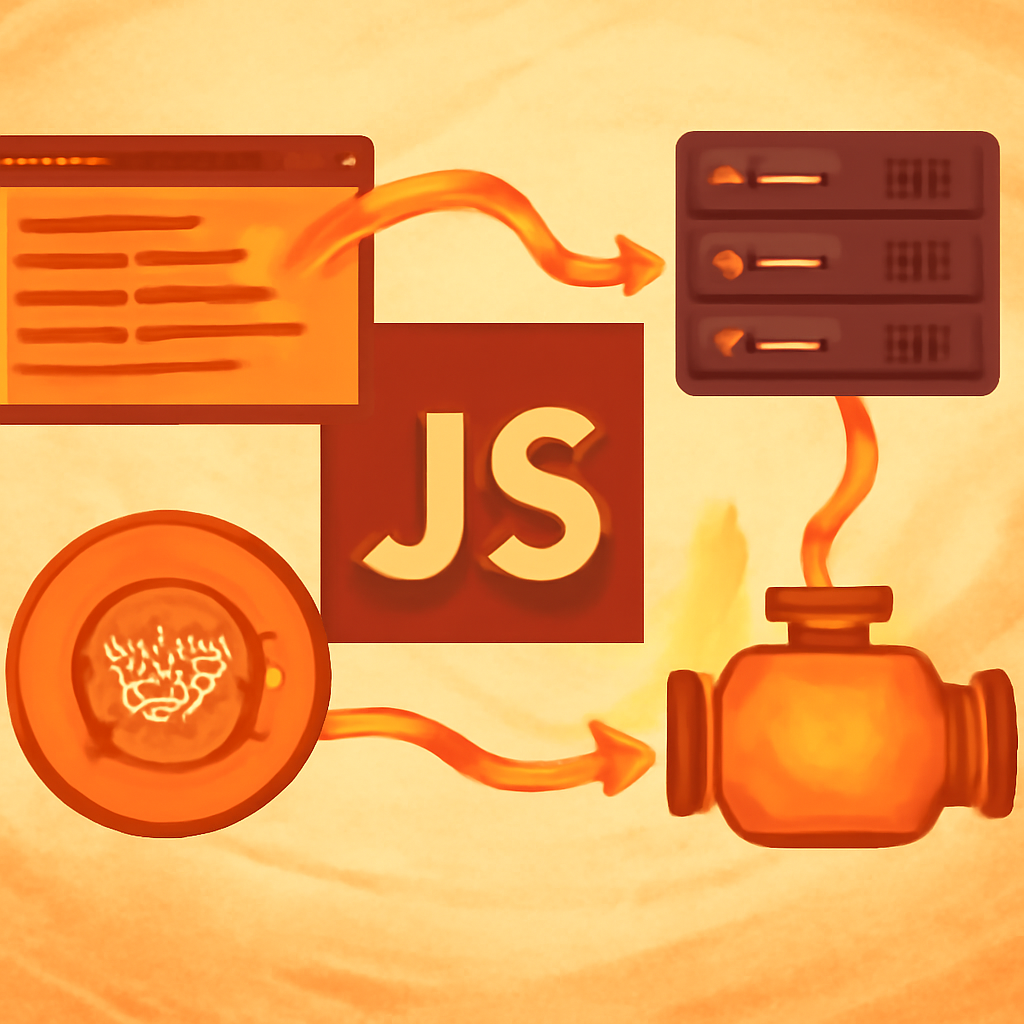
JavaScript is the language that powers interactive web pages and a huge portion of modern software. It began as a lightweight scripting language for browsers and has evolved into a general-purpose language that runs in many environments. Understanding how JavaScript executes and where it’s used helps you write faster, more reliable code.
What JavaScript is at a glance
JavaScript is a high-level, dynamic, prototype-based language with first-class functions and automatic memory management. It is standardized through the ECMAScript specification, which drives language syntax and core features. While browsers supply extra Web APIs (DOM, fetch, Web Workers, etc.), the language core defines behavior like functions, objects, and the module system.
How JavaScript runs
Two distinct parts make up a typical JavaScript runtime: the language engine and the surrounding host environment. The engine parses source text, compiles or interprets it (modern engines use multiple tiers including just-in-time compilation), and manages memory and garbage collection. The host environment supplies APIs and I/O: a browser provides the DOM and rendering, while a server runtime provides networking and file system access.
The event loop and single-threaded model
JavaScript itself runs on a single main thread in most environments. Concurrency is handled by an event loop that processes tasks (like user input or network callbacks), runs microtasks (promise callbacks and other small units) between tasks, and schedules rendering. This model lets developers write asynchronous code without traditional multithreaded locking, but it also means CPU-heavy work can block the main thread and freeze interfaces.
Parallelism and background work
To avoid blocking, environments provide ways to run work off the main thread. Browsers have Web Workers for background computation and the internals of the browser itself can offload rendering and I/O. On the server side, runtimes like Node.js use an underlying engine and operating-system capabilities to manage asynchronous I/O efficiently while keeping JavaScript execution largely single-threaded by design.
Common engines and runtimes
Several major JavaScript engines implement the language: V8 (used by Chrome and many server runtimes), SpiderMonkey (Firefox), and JavaScriptCore (Safari). Server-side Node.js is commonly paired with V8 to run JavaScript outside the browser. Each engine implements the ECMAScript spec and adds optimizations and tooling that affect performance and debugging.
Practical tips and best practices
- Learn the event loop: understanding tasks vs microtasks and where rendering fits prevents surprising behavior with promises and timers.
- Avoid long-running synchronous loops on the main thread; break heavy work into chunks or use workers.
- Prefer promises and async/await for clearer asynchronous code; handle errors explicitly.
- Use modern language features (modules, let/const, destructuring) for maintainability and fewer bugs.
- Measure performance in the target environment—different engines optimize differently.
JavaScript’s ubiquity means it’s worth understanding both the language and the runtime. Knowing how engines execute code and how the event loop schedules work helps you write smoother, faster applications—whether the code runs in a browser, on a server, or in an embedded environment.

