
How JavaScript actually runs
JavaScript is a language spec that runs inside host environments (the browser, server runtimes, embedded engines). The language itself follows an execution model where your code runs to completion on a single main execution thread, while the surrounding runtime provides APIs to perform I/O, timers, and other work without blocking that main thread.
The event loop and run-to-completion
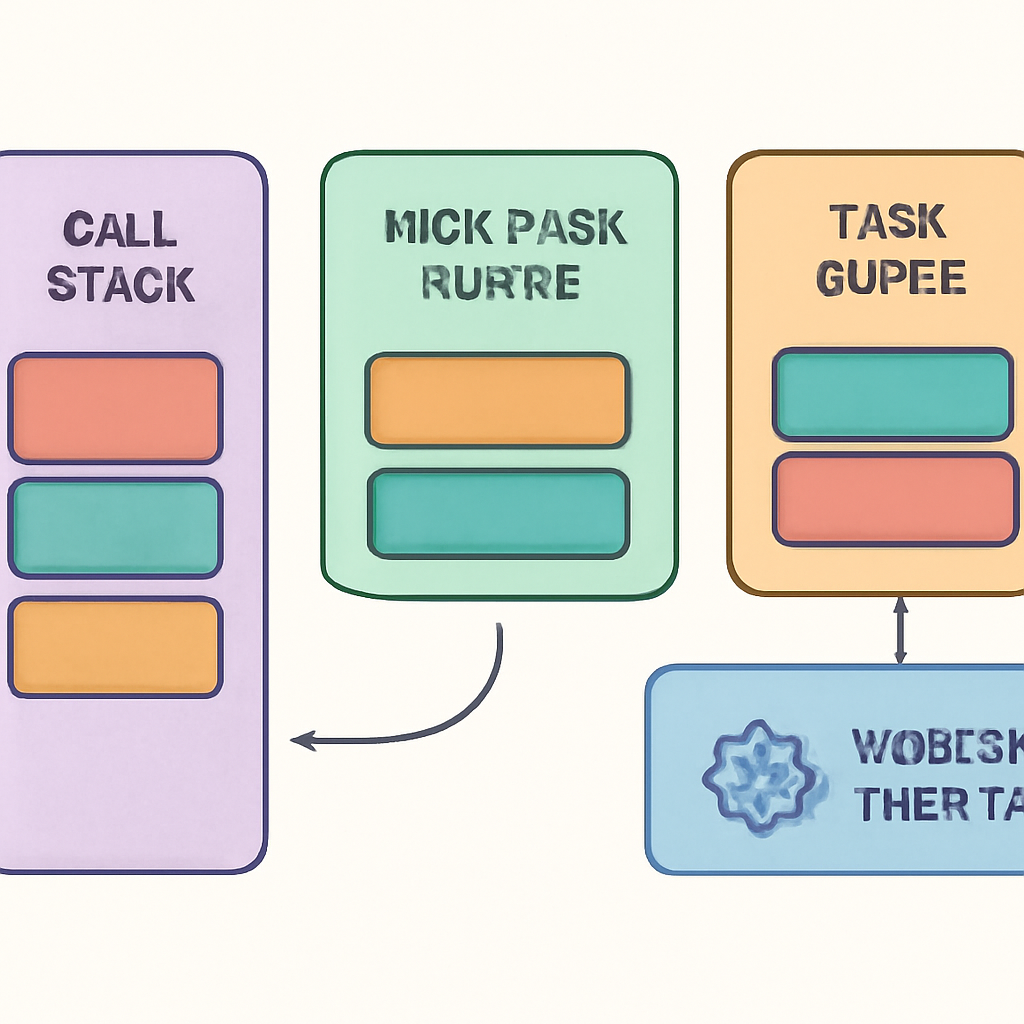
The event loop is the scheduling mechanism the runtime uses to coordinate asynchronous work. When the call stack is empty, the event loop picks a pending task (sometimes called a macrotask) and runs it to completion. After each task, the runtime drains any pending microtasks (for example, resolved Promise handlers and queueMicrotask callbacks) before continuing. That run-to-completion guarantee is what keeps application state predictable during each handler.
Microtasks versus tasks and why it matters
Microtasks run earlier and more frequently: they are drained at the end of each task, and newly scheduled microtasks are executed before returning control to the event loop. That ordering means Promise callbacks will typically run before a next timer tick or UI update, so understanding microtask timing helps avoid surprising ordering bugs and infinite microtask loops.
Differences across environments
Host environments implement the event loop differently in details that matter to developers. In browsers, the event loop integrates with rendering and DOM events; in some server runtimes, a native library provides the loop and thread pool. For example, some server runtimes expose an additional “next-tick” queue that can run before Promise microtasks — making order-sensitive behavior different between module types and platforms.
Modern language features that shape runtime code
Since ECMAScript 2015, the language standardized modules, block scoping (let/const), classes, and Promises; later editions added async/await, dynamic import(), and other operators that change how asynchronous code is written and organized. The formal ECMAScript specification documents these language features and how engines must behave for compatibility.
Patterns to write predictable async code
- Favor Promises and async/await for clearer control flow over nested callbacks.
- Avoid long-running synchronous work on the main thread; use workers or offload to a thread pool for CPU-heavy tasks.
- Use queueMicrotask or platform-recommended microtask APIs when you need a guaranteed immediate callback after the current job, and be mindful of infinite microtask loops.
These patterns keep interfaces responsive in browsers and prevent starvation of other events in server runtimes.
Practical takeaway
Think of JavaScript as a single-threaded language with a cooperative scheduler supplied by the runtime. Learn the event loop’s task vs microtask ordering, prefer modern async constructs for clarity, and move heavy computation off the main thread. That mental model will make debugging and performance tuning far more reliable across browsers and server environments.

