
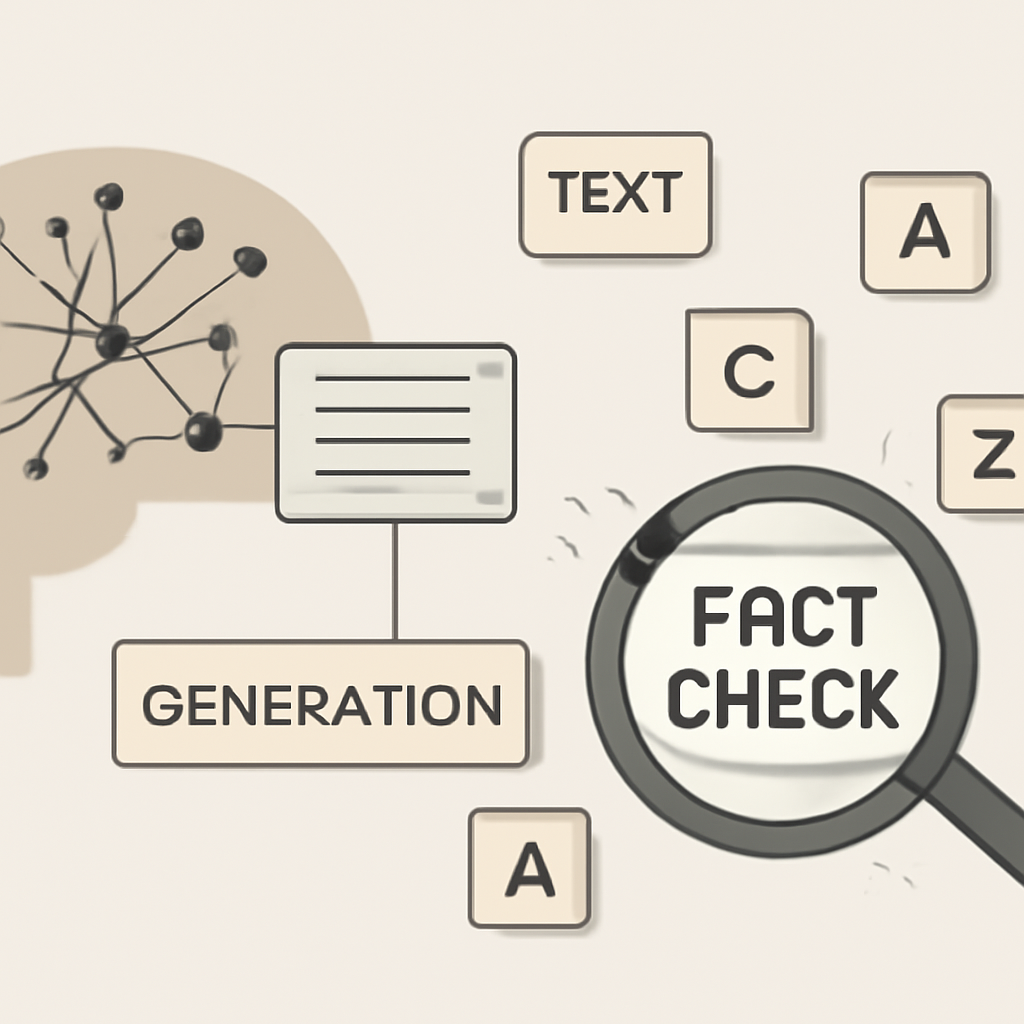
Generative AI models produce fluent text by predicting which piece of language comes next, not by consulting a database of verified facts. That predictive process makes them fast and flexible, but it also creates room for confident-sounding errors — often called hallucinations — when the model guesses rather than verifies.
How these models learn
Training starts with massive exposure to text so the model learns statistical patterns of language: sequences of tokens (the units models read and write) and how those sequences typically continue. During pretraining the model optimizes a next-token objective: it learns which token is most likely to follow given context, across billions of examples. Larger models trained on more data and compute tend to perform better, following predictable scaling relationships observed in research.
Aligning models with human goals
Raw pretraining doesn’t teach a model to follow human instructions or to prefer truthful restraint over made-up answers. To address that, developers use techniques like supervised fine-tuning and reinforcement learning from human feedback (RLHF), where human raters compare outputs and a policy is optimized to prefer helpful, safe, or accurate responses. This alignment step improves usefulness but does not eliminate all factual errors.
Why hallucinations happen
Hallucinations arise from multiple interacting causes: gaps or biases in training data, the next-token training objective that rewards plausible continuations rather than verifiable truth, evaluation or leaderboard incentives that favor fluent answers, and inference-time choices (like sampling settings) that increase creative but less reliable outputs. Architectural limits on how models store and retrieve long-range facts also contribute.
How systems reduce hallucinations
- Grounding with retrieval: combining a generator with a document retriever lets the model cite and condition on external sources at runtime, which reduces unsupported assertions.
- Fine-tuning and alignment: targeted fine-tuning and RLHF help models prefer safer, more conservative phrasing and to admit uncertainty.
- Evaluation and metrics: new benchmarks and human review focus on factuality and faithfulness rather than only fluency.
- Human-in-the-loop workflows: routing uncertain or high-stakes outputs for human verification before publication.
These mitigation strategies have measurable effects in research and production systems but none are perfect; retrieval-augmented approaches in particular have become a common, practical way to ground answers.
Practical tips for users and builders
- Ask models to show sources or evidence and prefer systems integrated with retrieval or databases for factual tasks.
- Design prompts that request uncertainty estimates (e.g., “I may be wrong—please verify”) and use conservative decoding settings when accuracy matters.
- Use small, repeatable test sets and human review to track hallucination types and frequency before deploying in critical contexts.
- Combine automated checks (fact-checking models, citation matching) with human oversight for important decisions.
Understanding the strengths and limits of generative AI — that it is powerful at pattern completion but not a guaranteed oracle — helps teams choose the right architecture, guardrails, and review processes to get reliable results.

