
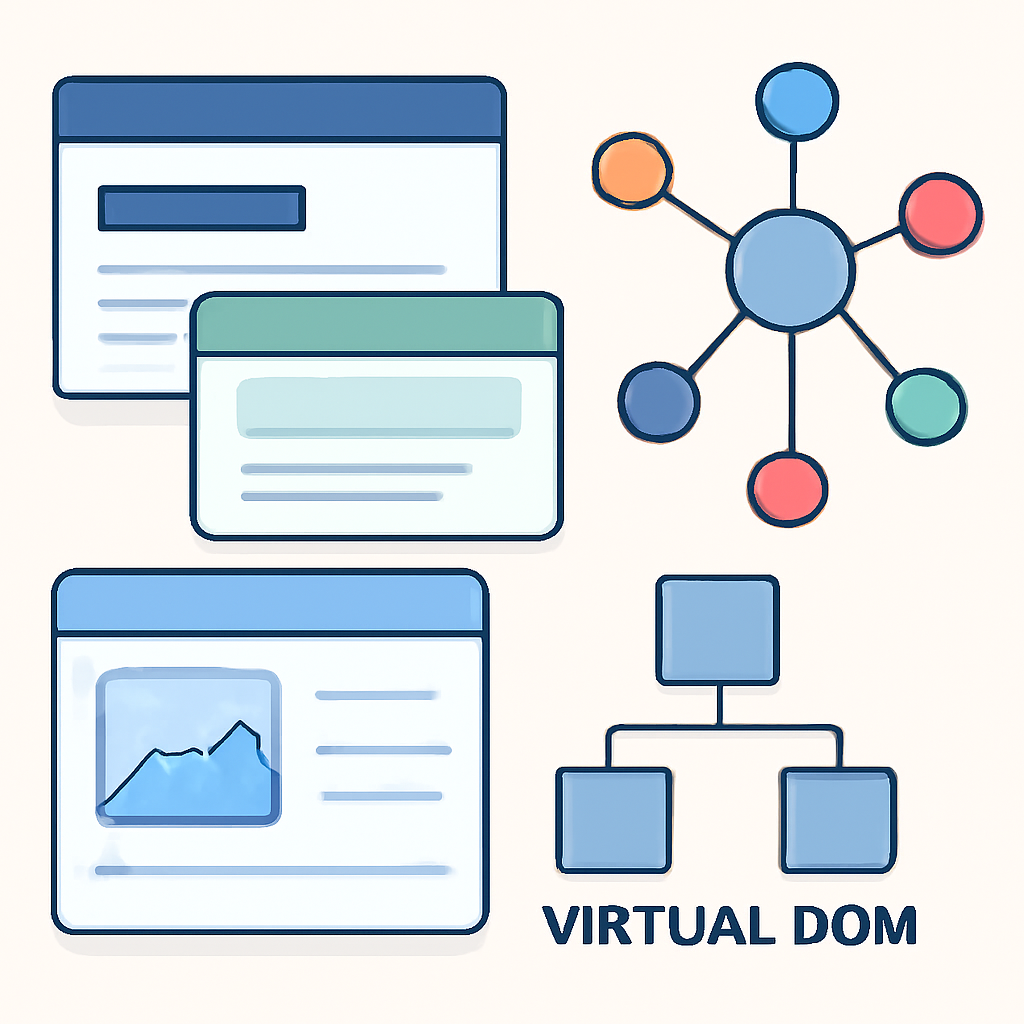
React is a JavaScript library for building user interfaces from composable pieces called components. It focuses on declarative rendering: you describe the UI for a given state and React figures out how to update the browser efficiently when that state changes. This model makes components predictable, testable, and easier to reason about compared with imperative DOM manipulation.
Core concepts
Components: The basic building blocks. Components are reusable functions (or classes historically) that return UI. Most modern code uses function components.
JSX: A syntax extension that looks like HTML inside JavaScript. JSX compiles to plain JavaScript calls and makes component templates concise.
Virtual DOM: React maintains a lightweight representation of the DOM and computes minimal updates to apply in the browser — that’s why small state changes don’t require full page redraws.
Modern features that matter
Hooks: Functions such as useState and useEffect let function components manage local state and side effects without classes. Hooks enable cleaner abstractions and encourage splitting logic into reusable units.
Concurrent rendering and transitions: React’s newer rendering strategies reduce jank by letting the renderer interrupt or delay nonessential updates, improving perceived responsiveness for complex apps. APIs for marking updates as transitions let you prioritize urgent updates (like typing) over heavier UI updates.
Server Components and Server Actions: These let some parts of the UI render on the server without shipping their JavaScript to the client, reducing bundle size and improving initial load performance for data-heavy interfaces. Server Actions enable server-run logic that feels like calling a function from the client.
React Compiler and optimizations: New tooling in the React ecosystem aims to produce smaller, faster output by analyzing component code and emitting optimized JavaScript and HTML coordination patterns. These advances change how libraries and apps are bundled and hydrated.
When to choose React
- If you need a component-based approach with a mature ecosystem (routing, state libraries, testing tools), React is a strong fit.
- React is particularly useful for complex interactive UIs, single-page apps, and projects that will evolve over time where component reuse and maintainability matter.
- If you prefer minimal upfront JavaScript or server-driven patterns, consider adopting Server Components selectively to reduce client bundle cost.
Practical upgrade and development tips
- Use function components and Hooks for new code; they simplify state and side-effect patterns compared with classes.
- Adopt concurrent-aware APIs (like transitions) gradually — they are opt-in and designed to be nonbreaking for existing code paths.
- Evaluate where Server Components can reduce client bundle size (data-fetching components and heavy utilities are good candidates).
- Keep an eye on the official upgrade guides and the release changelog when updating major versions; testing and staged rollouts reduce risk.
React remains a practical choice for teams that value a large ecosystem, strong community tooling, and flexibility in rendering strategies. By understanding modern features (Hooks, concurrency patterns, server-driven rendering) and applying them where they fit, teams can build faster, more maintainable UIs without rewriting established codebases overnight.

